Harmonizing Eras: Neoclassical Piano Concertos by WindFlashAI
Harmonizing Eras: Neoclassical Piano Concertos by WindFlashAI · Jason Guo · 2026-07-09 · neoclassical, piano concerto, modern classical, minimalism, composition
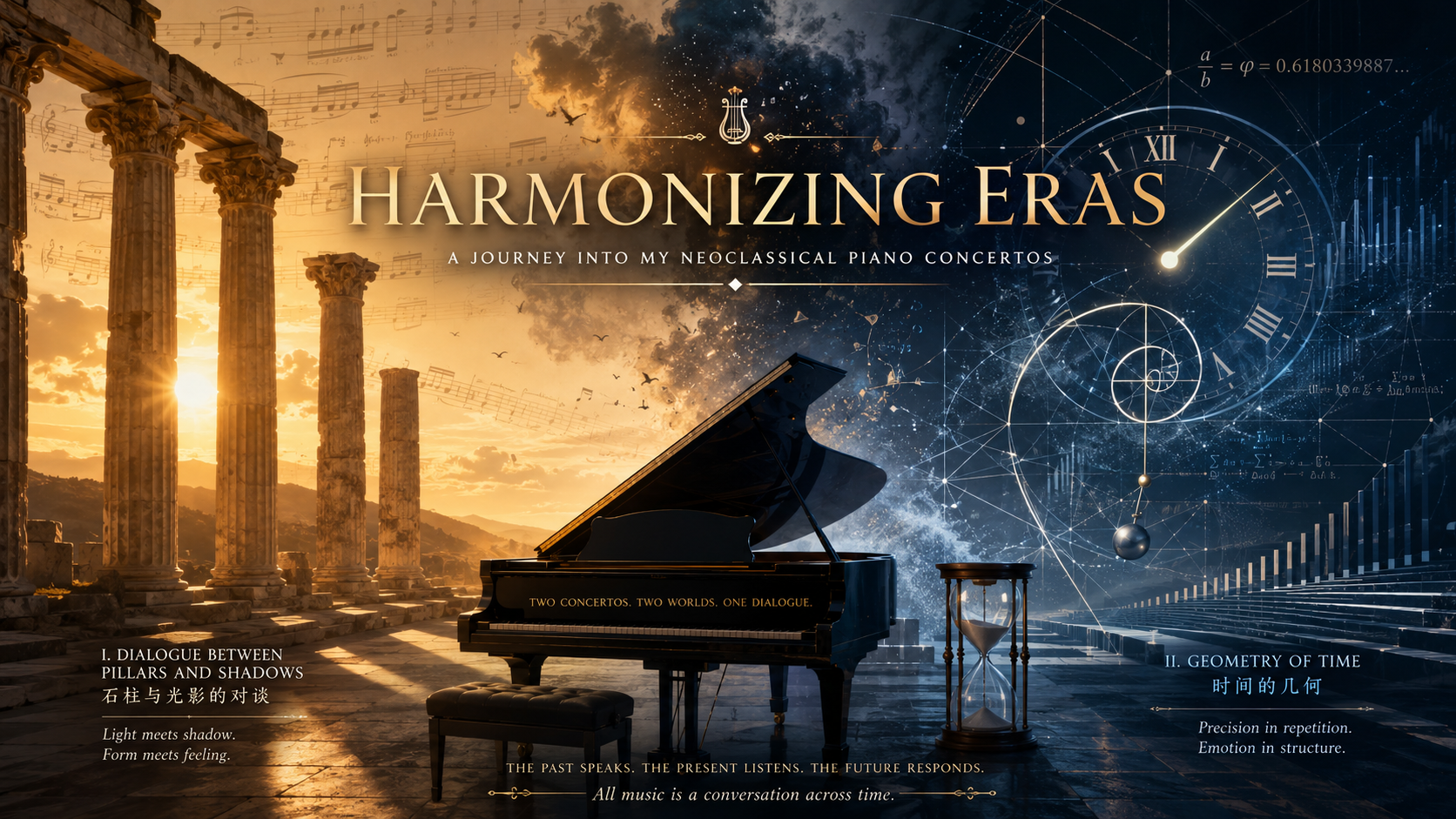
Introduction Neoclassicism is more than just a revival. it is a living dialogue between the structured elegance of the 18th century and the emotional complexity of the modern world. As a composer, I have always been fascinated by how the past can speak to the present—how the clear lines of a Bach fugue or the balanced phrases of a Mozart sonata can become the foundation for entirely new emotional landscapes. My latest two compositions, "Dialogue between Pillars and Shadows" and "Geometry of Time," represent two distinct explorations of this timeless aesthetic. Each piece is a journey: one into the warmth of light and shadow, the other into the cold precision of time. Together, they form a diptych that reflects my ongoing quest to blend the old with the new, the rational with the passionate. I. Dialogue between Pillars and Shadows (石柱与光影的对谈) The Concept This piece serves as an homage to the classical grandeur of the Enlightenment. Imagine yourself standing in the ruins of an ancient Greek temple at dawn. The sun rises slowly, and its first rays filter through the marble columns, casting long, shifting shadows across the stone floor. The "pillars" in this metaphor represent the rigid, classical form—the conventions of sonata-allegro, the clear diatonic harmonies, the balanced phrasing. The "shadows" are the modern, fluid harmonies that dance between them—chromatic inflections, unexpected modulations, and tonal ambiguities that would have been unthinkable in the 18th century. The piece is a conversation between these two worlds: the stable and the fleeting, the eternal and the ephemeral. https://windflashai.com/music Musical Characteristics The concerto opens with a solo piano statement that could have come directly from a Mozart sonata: a bright C major arpeggio, perfectly balanced, almost naive in its purity. But then, as if a shadow suddenly falls, the string section enters with a sustained cluster chord, dense and unresolved. This sets the stage for the entire work: a constant interplay between clarity and haze. The piano writing is virtuosic, with rapid scales, trills, and broken chords that show the influence of the classical keyboard tradition. However, the harmonic language is decidedly modern. At key moments, the strings introduce filmic, cinematic swells—think of the dramatic string writing in a John Williams score—that lift the piano lines into an emotional realm far beyond the classical salon. The middle section features a slow, meditative dialogue between the piano and the solo cello, where the "pillar" of a simple repeated note is surrounded by "shadows" of microtonal portamento in the strings. The piece ends as it begins: a single, pure C major chord, but this time held by the entire orchestra, as if the shadows have finally dissolved into light. Why This Matters "Dialogue between Pillars and Shadows" is not merely a pastiche; it is a genuine attempt to find a new language that respects the past without being trapped by it. In an era of chaos and information overload, there is something deeply comforting about returning to forms that have survived for centuries. Yet, we cannot simply copy them; we must let our own shadows fall across them. This piece is my answer to that challenge. II. Geometry of Time (时间的几何) The Concept In contrast, "Geometry of Time" leans into the minimalist side of Neoclassicism. Here, music is treated as a mathematical beauty—a structure that reveals itself through repetition, symmetry, and gradual transformation. The concept came to me while watching the second hand of a clock sweep around its face. Each tick was identical, yet the accumulation of ticks created a sense of motion, of time passing. Similarly, in this concerto, the piano begins with a simple, interlocking motif—a 16th-note pattern that repeats with minor variations, like a geometric pattern evolving. This is music about precision, about the beauty of a ticking clock, about the repetitive yet ever-changing patterns of life itself. Musical Characteristics Driven by a steady 120 BPM (the tempo of a human heartbeat, as well as many dance forms), the piano explores rhythmic, interlocking motifs that build upon each other. The opening is almost mechanical: the piano plays a series of five-note cells that spiral upward, while the strings provide a static, drone-like harmonic foundation. As the movement progresses, the motifs become more complex—syncopations, cross-rhythms, and polyrhythms emerge. The emotional weight comes from the "intersections" of these musical lines: moments where the driving, sharp piano melodies meet the soaring, poised orchestral swells. I deliberately avoided any traditional harmonic progression; instead, the harmony emerges from the layering of independent lines, much like a Steve Reich phase piece. The second movement slows to 60 BPM, creating a sense of suspended time. The piano plays long, held notes while the strings weave a web of harmonics and glissandi. The third movement returns to 120 BPM but with a twist: the motif is now inverted and played at half tempo by the brass, while the piano races ahead at double speed. The effect is dizzying, yet strangely ordered—a geometry of time itself. The Connection to Mathematics In preparing this piece, I studied the concept of "golden ratio" proportions and used them to structure the sections. The climactic point of the concerto falls at exactly 0.618 of the total duration. I also employed nested repetition patterns: small rhythmic cells that repeat, then larger structures that repeat those cells, creating a fractal-like architecture. Music, like mathematics, is about relationships; the beauty lies in discovering how parts relate to the whole. III. The Intersection of Two Works While these two concertos are independent, they share a common thread: both are attempts to find clarity through constraint. In "Dialogue between Pillars and Shadows," the constraint is the classical form; in "Geometry of Time," the constraint is the minimalist process. Yet within these constraints, I found immense freedom. The pillars shaped the shadows; the geometry gave birth to emotion. When I perform them back-to-back, I feel as if I am exploring two sides of the same coin: one warm and architectural, the other cool and structural. What Neoclassicism Means to Me Today Neoclassicism is often misunderstood as mere imitation. But true neoclassicism is a re-evaluation—a stripping away of the excesses of Romanticism (its bombast, its endless chromaticism, its emotional indulgence) to return to a more balanced and formal expression. Yet, we cannot simply ignore the last two centuries of music. My works are not Beethoven symphonies dressed in modern clothes; they are my own voice, using the grammar of the past to speak of the present. The "modern" is not something we add on top of the "old"; it is something we find within it, by seeing the old with new eyes. Conclusion These two works remind us that the "Old" is never truly gone. By stripping away the excess of Romanticism and returning to balance and form, we find a new way to express the intricate feelings of today. The shadows that dance between ancient pillars, the geometry that ticks like a clock—these are not retreats into history, but advances into a future where the past is always present. I invite you to listen with fresh ears, to hear the dialogue between what has been and what is becoming. In the end, all music is a conversation across time, and these two concertos are my part of that endless dialogue. --- Written with the hope that the harmonic eras may find harmony in the hearts of listeners.