I Reopened Two AI Christmas Card Test Orders: The 300 dpi PDF Holds Up, With Caveats
AI Christmas Card PDF, 300 dpi Verified, With Caveats · Jason · 2026-11-04 · Christmas card
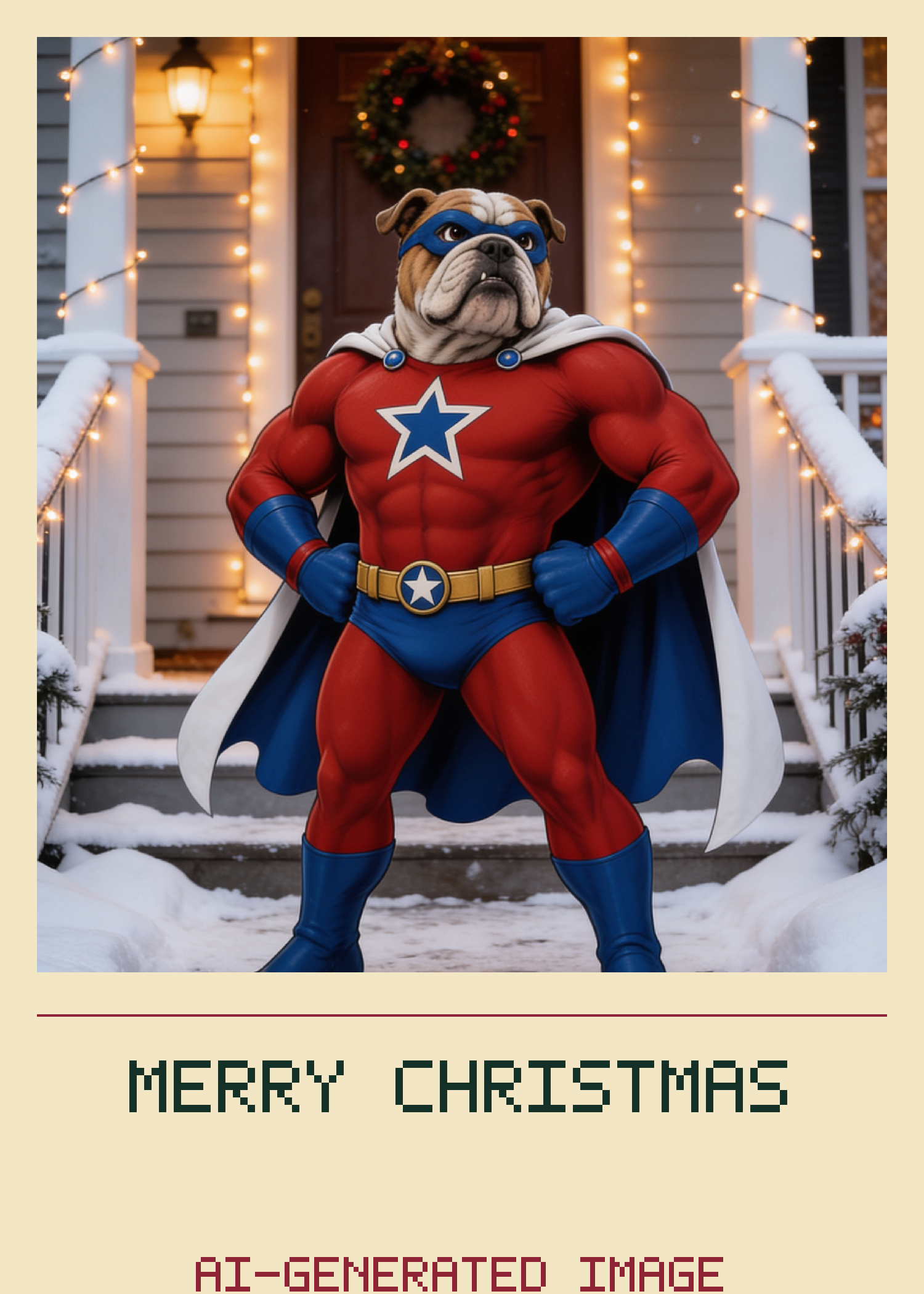
Disclosure: WindFlash AI operates AI Christmas Photo Generator. This is a first-party review, not an independent lab test. I did not buy a new pack for this article. Instead, I reopened two completed test orders from October 26, 2026, downloaded the files again on November 5, and inspected their actual dimensions and PDF structure. Current prices and policies were checked separately on November 5. The short version: the print files are real, not just a social-media image with a “300 dpi” label. The 5×7 order produced a 1500×2100 card PNG and a one-page PDF with a 5×7-inch page and a 300 ppi embedded image. A second order successfully combined three source photos into a scene with two adults and Santa. But there are still things worth checking before you print: likeness is not guaranteed, the card layout can crop the portrait more tightly, and the privacy policy does not answer every question about provider retention or backups. What I actually tested The first completed order used one photo , the Snowy porch scene, and the 5×7-inch print format. Its result is a bulldog in a superhero costume standing on a snowy, light-covered porch. The order page offered three downloads: the finished card, the portrait without the card layout, and a print PDF. The actual card downloaded from the first test order. The PNG is 1500×2100 pixels. The second completed order used three photos , the Photo with Santa scene, and the 4×6-inch print format. The finished portrait contains two adults standing beside Santa. This is the more useful test of the multi-photo workflow because the people and Santa had to be assembled into one coherent scene rather than merely changing the background of a single group photo. These were existing test orders, not customer orders. I am not publishing the order links or account details. The card images in this article are the actual October 26 outputs, including the block-letter layout used in those files. The 5×7 file really is 1500×2100 I downloaded the 5×7 card again and checked the PNG itself. It is 1500 pixels wide by 2100 pixels high . The standalone portrait is larger, at 1920×2688 , so the card and the standalone portrait are separate outputs rather than the same file under two names. The PNG's metadata reports 72 dpi. That number alone is not a problem: pixel dimensions and the physical size at which those pixels are placed determine the effective print resolution. A 1500×2100 image placed at 5×7 inches gives 300 pixels per inch in both directions. The PDF confirms that placement. pdfinfo reports: One page 360×504 points , which is exactly 5×7 inches at 72 points per inch No encryption pdfimages -list reports one embedded 1500×2100 RGB image at 300×300 ppi . That is stronger evidence than a marketing claim or a DPI metadata field: the PDF has the right physical page and enough pixels for that page. The 4×6 order passed the equivalent check. Its card PNG is 1200×1800 , and its one-page PDF is 288×432 points , or 4×6 inches. The embedded image is 1200×1800 at 300×300 ppi . For home printing, I would still select “Actual size” or 100% scale and check the print dialog before using good paper. That is ordinary print hygiene, not a defect in these files. The three-photo test worked, but inspect the crop The three-photo Santa order produced a complete, readable scene. The two adults have distinct clothing, hair, and faces; Santa appears as a separate person beside them rather than replacing either face. The full-length portrait also keeps all three figures in the frame. There is an important difference between the portrait and the card. In this October file, the card's photo window is a tighter crop. Santa's hat is cut by the top edge in the card even though the standalone portrait shows the full hat. That does not make the card unusable, but it means the portrait download is worth keeping and the finished card deserves a visual check before printing. The actual 4×6 card from the three-photo test order. Santa's hat reaches beyond the card's top crop. The standalone portrait downloaded from the same order keeps the full hat and all three figures in frame. The text layer did not suffer from the usual image-model spelling problem. “MERRY CHRISTMAS” and “AI-GENERATED IMAGE” are legible and correctly spelled in both card files. They are typeset on the card rather than left for the image model to invent. What I can say about face consistency—and what I cannot The public fireplace example uses a staged photo of two adults, not a customer photo. Comparing that published before-and-after pair, the two people remain recognizably the same, with their hair, clothing, and overall facial structure preserved. The result is not pixel-identical: skin and small facial details are smoothed, as is common with AI editing. The staged input used for the public fireplace sample. This is not a customer photo. The published Seedream 4.5 Edit output. The scene changes substantially while the people remain recognizable, with some facial smoothing. That is a review of a published sample, not a fresh independent generation. For the older three-photo order, the original uploads have already been deleted under the product's retention policy, so I could not perform a new side-by-side comparison against those source faces. I can describe the finished composition, but I cannot honestly turn that into a numerical face-match score or a promise that every family photo will retain likeness equally well. If a face matters more than the scenery, use a sharp, well-lit source and inspect the result at full size. A generator can produce a plausible person who still does not look enough like the person in your photo. Current pricing, checked separately from the old orders The current pricing page lists one-time credit packs: 1 credit: $4.99 , enough for one card 3 credits: $9.99 , about $3.33 per card 8 credits: $19.99 , about $2.50 per card There is no subscription, no auto-renewal, and no free generation. Unused credits remain on the account until spent. These are the prices visible on November 5; I did not make a new purchase for this review, so this is a price-page check rather than a fresh checkout test. The lack of a free tier will be a drawback if you only want to experiment. The advantage is clarity: one credit makes one card, and a pack does not quietly turn into a recurring plan. Privacy and refunds: policy evidence, not a security certification The privacy policy says uploaded originals are deleted when the portrait is saved, while finished downloads remain for 30 days after payment. It says photos are sent to fal.ai for generation with ByteDance Seedream 4.5 Edit, that the site does not train a model on them, and that Waffo processes payment without the site receiving or storing the card number. The two old order pages still showed a download expiry of November 25 when I rechecked them, matching 30 days after their October 26 payment. That verifies the displayed retention window, not the deletion of every copy from every system. I did not test post-expiry deletion, provider-side retention, or backup behavior. The public policy does not give a detailed fal.ai retention period or a backup-deletion timeline, so those remain open questions rather than facts I can fill in. The refund policy offers a 14-day window from payment for failed generation, unavailable files, or an unusable result. A request goes to the support email with the order ID and account email. Refunds are confirmed through Waffo, and downloads are disabled after a refund. Orders violating the acceptable-use policy are excluded except where law requires otherwise. I did not request a refund for either completed order, so I am describing the published process, not claiming to have tested refund speed. Verdict AI Christmas Photo Generator does the part that many image tools leave vague: it produces known-size card files and a real print PDF. Both existing orders passed the file-level checks, and the three-photo test shows that the product can assemble multiple inputs into one Christmas scene. I would consider it when the goal is a quick card from one to four photos, with no subscription and a clear one-time price. I would not treat it as a free trial, a guarantee of perfect likeness, or an independent privacy audit. Check the faces, check the card crop against the standalone portrait, and keep the original files you care about. For a first-party review, those limits matter as much as the successful export. The useful evidence is not “AI makes great Christmas cards.” It is that the downloaded 5×7 PDF really contains a 1500×2100 image at 300 ppi—and that you can inspect the result before sending it to print.