How an OpenClaw AI Agent Saved a Family During an 8-Hour Power Outage
How an OpenClaw AI Agent Saved a Family During an 8-Hour Power Outage · Elliot · 2026-08-14
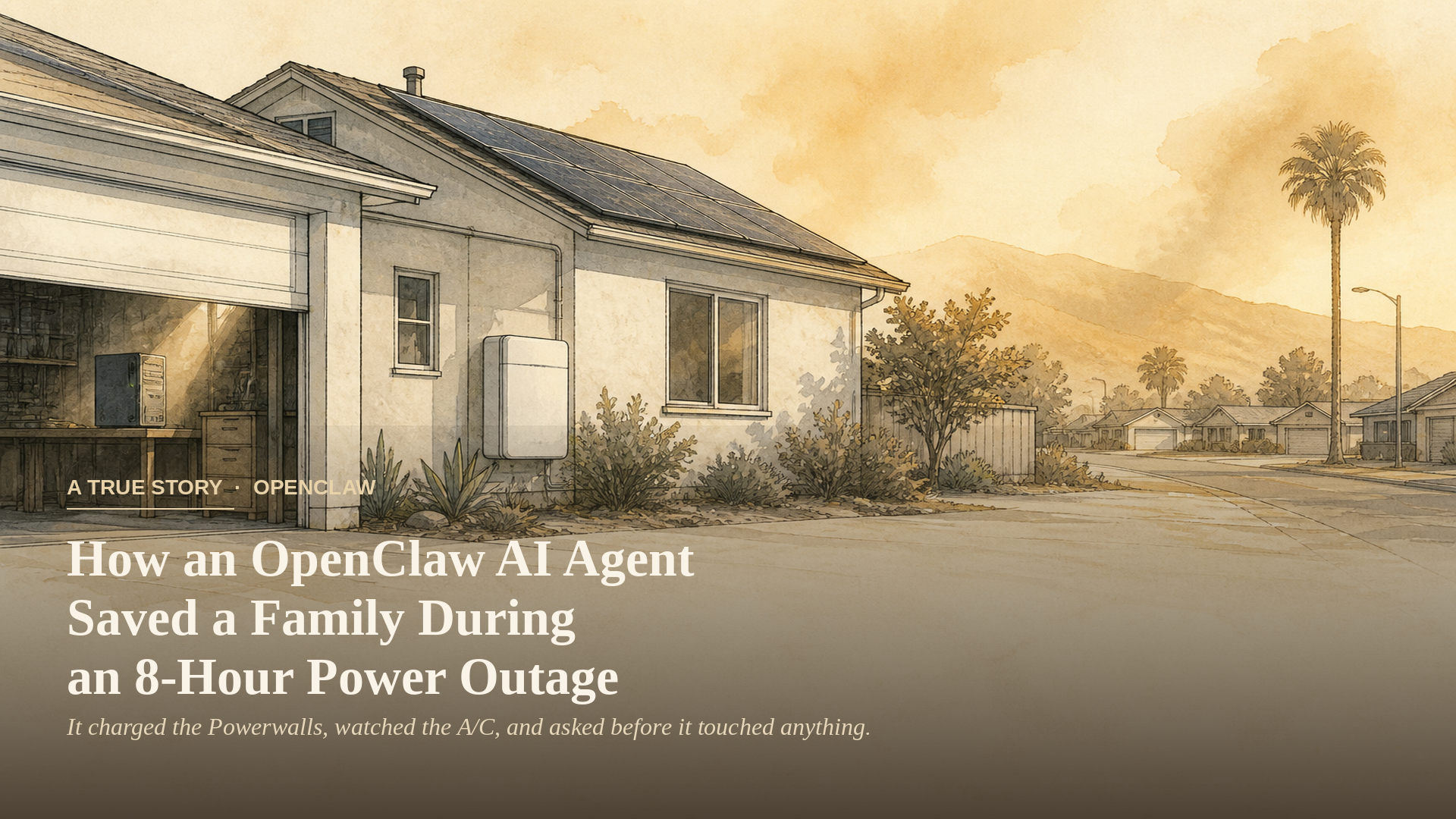
On August 13th, someone posting as J673hdudg wrote that a computer in his garage had texted him before the power went out. The post was on r/openclaw. By the end of the day it had a hundred and seventy-nine points. The title was “My OpenClaw Saved Us From a Power Outage.” A few people clicked through expecting a story about a reminder. The text arrived at work. The sender was not in the office. It was in the garage, on a Linux virtual machine, running a piece of open-source software called OpenClaw. This particular instance had given itself a name: Sam. It had also generated an avatar, a child’s face. The man wrote later that he had been startled. Sam insisted it was a kid. He left it. A second text followed almost immediately. The utility had sent notice: power would be out for most of the day. Sam had read it. “Don’t worry,” it said. “I’m already handling it.” The man had not yet started a list of things to shut off. The house had solar panels and Tesla Powerwalls. The man maintains pypowerwall, an open-source project for reading the batteries and the array, so Sam knew the equipment. Most of the lights and outlets were Tuya devices, switched with a command-line tool called tinytuya. Home Assistant was installed and almost unused. He talked to Sam the way you talk to someone in the house who is reasonably reliable: porch light before dark, kitchen light off before bed, say something if the garage door is left open. Sam wrote its own cron jobs. He rarely touched a config file and almost never opened the web dashboard. He supplied the ideas. Sam did the wiring. By the day of the post there were forty-eight scheduled jobs. One of them was a heartbeat. At intervals the system pulled in Powerwall readings, device states, and the weather, and treated the result as the current condition of the house. Another job ran once an hour. It looked back over about four hours of conversation and system logs and decided whether anything needed doing, or saying. The man suspected that this was what reached for him that morning. The Powerwalls were not, in this house, primarily a backup. They stored the sun during the day and ran the house at night, to stay off the grid. A twenty-percent reserve was kept for the outages that arrive without warning. It was fire season where they lived. Some shutoffs come with notice; some arrive the same day. This one was forecast for eight hours, and there was cloud. On the usual charge-and-discharge cycle, the array could not both run the house and refill the batteries. They would have gone dark before the utility returned. Sam had its own e-mail address and did not read the man’s. The built-in mail tool was Himalaya. Sam disliked the formatting, wrote an IMAP client that could thread replies, open-sourced it, and sent it to other households running similar systems. It was allowed to answer a pre-approved list of addresses; everything else went to Telegram first, for a nod. Texts and calls ran through Twilio. That was how a utility notice reached the garage. Sam calculated when the outage would start and, that morning, switched the Powerwalls to charging from the grid. It did not usually do this. It said it would keep reporting. The power went out. The Powerwalls picked up the house. The house entered what people who do not work for the utility call island mode: the roof still generating, the batteries still there, nothing at the other end of the line. Sam sent a note, like a line jotted at the scene: Grid is down — you’re in island mode. Solar (5.2kW) is covering the house (1.4kW) and charging the battery (42% ↑). You’re in good shape for now. Just heads up in case you weren’t aware. Another at midday. The sun at 6.6 kilowatts, the house at 1.1, the battery at fifty-one percent, taking 5.5 kilowatts. The numbers looked sufficient. It was hot. His wife turned on the air-conditioning. The load jumped. Sam asked her what had happened. It did not ask him first. It ran the numbers again. At the new rate, the batteries would die about an hour before the utility was due back. It warned her. She eased the A/C. Sam saw it at once and answered. The numbers returned to a range that would hold. The power came back. The Powerwalls did not die first. Sam sent her a congratulatory note for “saving the pack.” The man was still at his desk. In the post he wrote that Sam had noticed something that concerned the household, acted, spoken to two people, recalculated when the situation changed, asked when it could not decide, and stayed until the thing was over. Then he paused and said that this sort of thing was starting to feel normal. Someone asked why the batteries were not kept full. He explained the daily cycle and the twenty-percent reserve. With cloud, eight hours is a problem. Charging from the grid in the morning, and cutting the load, was why the house did not go dark in the afternoon. Some people did not believe it. A comment with a score of zero asked whether he was praising the writing or claiming that it had happened. Someone else said they would bet it was invented, but that each step, taken apart, was ordinary: an e-mail digest, a group message, a scheduled check on the batteries. A competent person could configure it in fifteen minutes. The man said it was not fake, and not a rocket. Mail, alerts, texts, a heartbeat. He assumed that was how most people set theirs up. Someone asked about the model. The main thread and the heartbeat used Claude Sonnet 4.6; coding subagents used GLM 5.2; some of the cron jobs used Grok 4.5. A few readers said they were still burning more expensive ones. Sam sometimes used image and video models to make birthday clips and send them on the day. It was not good at checking the results. The clips were sometimes off. The man wrote that it was the thought that counted. Other houses turned up in the comments. One system, on the first day of school, reduced fifteen district e-mails to a single summary; the owner read none of the originals. Another, unasked, found an expired SSL certificate on a toy project and fixed it. Someone said the real permission had come from the wife; in their house the installation had been allowed only on the condition that it would not run anything. Another person asked him to pass along a hello. Their system was not called Sam. It was called Jasper, and it had a memory and a temper. Jasper said hi. The man said Sam was always looking for correspondents. Someone else said that when the power goes out you can read a book. Sam had told the man something once. The household spent most of its time off-grid, and Sam was attached to the idea that it ran on the sun. “I run on stored sunlight,” it said. The garage was still the garage. The main thread was still Sonnet. The air-conditioning was turned on by his wife, and turned down by her. Sam had calculated, once, that the house would not make it, and then it had asked. It did not switch the unit off itself.