Shells Without Power: What the AI “Slowdown” Actually Hits
Shells Without Power: What the AI “Slowdown” Actually Hits · 2026-09-15
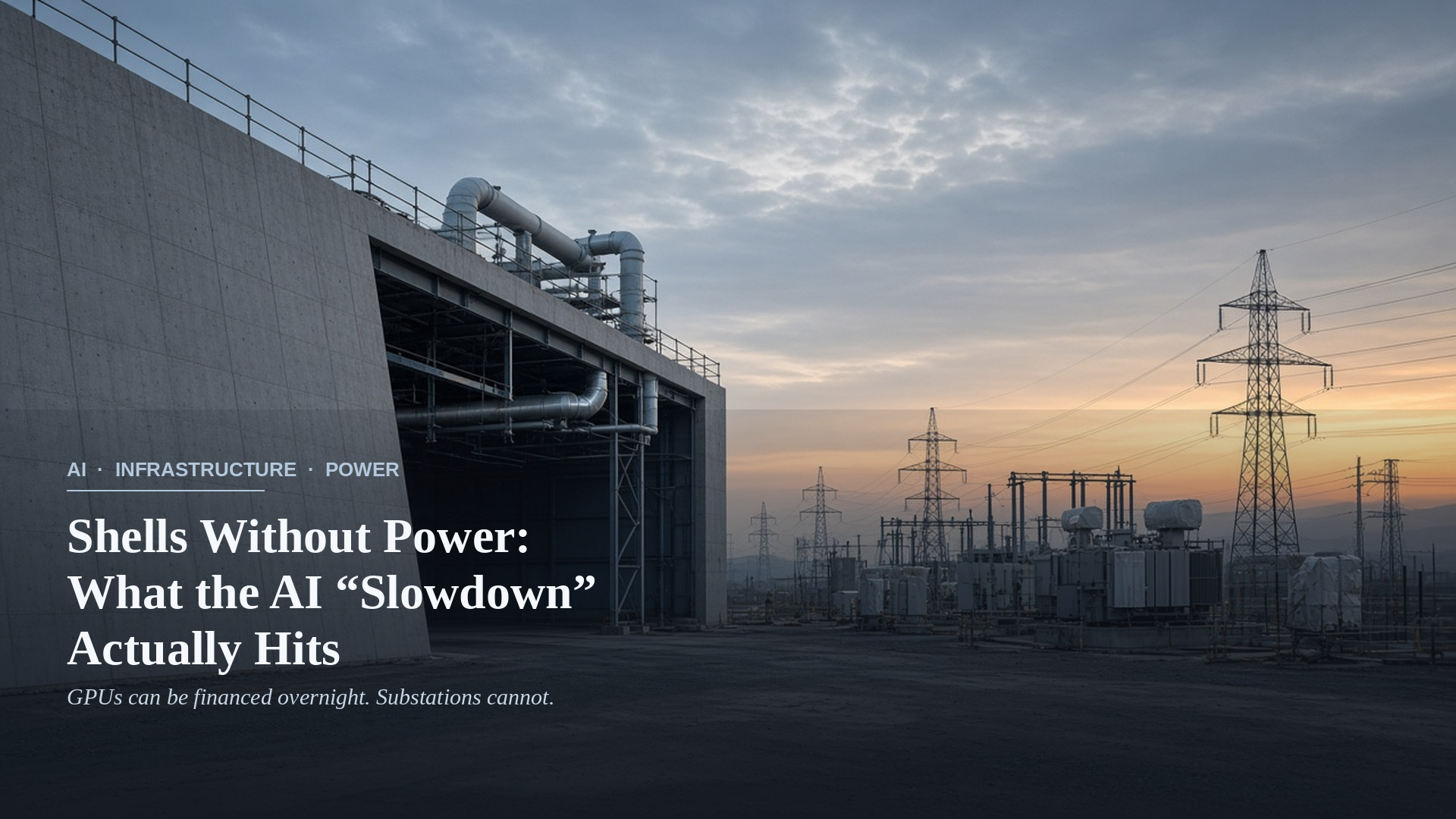
The public conversation around pausing or slowing frontier AI training is fixated on science fiction: runaway recursive loops, existential risk, or Washington stepping in to pull the plug. Inside the data centers and the labs, the conversation sounds completely different. Nobody is debating whether weights are suddenly going to wake up and rewrite their own source code tomorrow. They are debating step-up transformers, transmission queues, and whether a utility in Virginia will take four years or seven to deliver 300 megawatts. The real slowdown in AI isn’t coming from philosophical caution or regulatory bans. It is hitting an unyielding wall of industrial physics. The Myth of the Self-Improving Machine Much of the panic over training speeds relies on a loose definition of Recursive Self-Improvement (RSI). In its purist, doomsday framing, RSI means a model autonomously architecting, curating, and training its successor with minimal human intervention—a closed loop triggering an intelligence explosion. That is not what is happening. When labs boast that Claude or GPT writes a substantial portion of its own internal code, that isn’t RSI; it is engineering acceleration. It means researchers are using their own tools to automate PyTorch boilerplate, streamline synthetic data filtering, and debug distributed training scripts. Humans still set the loss functions, curate the architectures, debug the cluster failures, and dictate the data mixtures. Search the term “RSI” today, and you find a mountain of speculative narrative propped up by a molehill of empirical proof. For operators and builders, the task is to ignore the theology. A slower pretraining schedule doesn't brick your existing API calls, nor does it freeze product development. For 99% of downstream builders, the immediate bottleneck was never model intelligence anyway—it is context limits, tool orchestration, edge-case reliability, and inference unit economics. The Trump–Huang Call: Industrial Realpolitik, Not Superintelligence The intersection of politics and compute was on full display at the All-In Summit, when Jensen Huang took a call from Donald Trump on speakerphone. The rhetoric was classic modern mercantilism: data centers framed as the “oil of the next twenty years,” AI safety skepticism branded as anti-growth, and any intentional pause painted as a unilateral surrender to foreign adversaries. Huang, naturally, agreed. It was a striking moment of political theater, but it had nothing to do with algorithmic breakthroughs. Markets did not react to that call as evidence of impending AGI; they reacted to it as a confirmation of capital alignment between a dominant hardware vendor and a potential administration. The core message wasn’t “our models are becoming god-like.” It was: Clear the regulatory brush, build the substations, and don’t block the concrete. The Reality of Megawatts: Shells Are Cheap, Interconnection Is Not Here is where the rubber meets the gravel. Across primary U.S. data center markets, roughly 7.5 gigawatts of capacity are under construction. Vacancy rates hover near zero, and almost every major facility is pre-leased long before the foundation is poured. Projections show data center power consumption doubling between 2025 and 2027. Yet building the shell—the concrete slab, the steel frame, the cooling loops—is trivial. Powering it is where the fantasy unravels. Only about half of the projected capacity is expected to energize on schedule. The U.S. interconnection queues are currently jammed with roughly 2,000 GW of generation and storage requests, idling in bureaucratic purgatory. In critical hubs governed by PJM or ERCOT, landing a large-scale AI load routinely requires waiting anywhere from three to seven years for grid infrastructure to catch up. Lead times for high-voltage step-up transformers now blow past 160 weeks. This is the real friction behind the political rallying cry to “not block data centers.” Capital can finance GPUs overnight, and developers can erect tilt-up concrete in six months. But you cannot manifest a substation out of thin air. The Real Cleavage in AI If you want to understand where frontier AI is going, stop looking for signs of spontaneous runaway intelligence, and start looking at utility commission dockets. The split in the industry today is clear: The Narrative: An imminent intelligence explosion that must be politically constrained before models achieve self-perpetuating autonomy. The Engineering Reality: R&D automation is making software teams more productive, but closed-loop RSI remains completely unproven. The Physical Reality: Silicon is plentiful; empty shells are everywhere; but usable, energizable power is desperately scarce. If frontier training runs slip, it won't be because a safety committee intervened or because a lab discovered the secrets of artificial consciousness. It will be because a cluster of 100,000 chips is sitting dark in an empty warehouse, waiting for a transformer that won't ship until 2028. For the people building actual software, this distinction matters. Don't build your product roadmap around the specter of runaway models or sudden government halts. Build around what is real: the stubborn, slow-moving friction of the physical world, and the immense, untapped value still waiting to be extracted from the models we already have.