Locabrary is a small Korean channel that films vinyl listening sessions in bars and other rooms. This one was shot at Citizen Brewing Community in Incheon — the channel’s home turf, and the first space it ever filmed. The recording ran long, so it was split in two: Side B plays jazz funk, Brazilian music and soul; Side A, the one taken apart here, is the hard bop half.
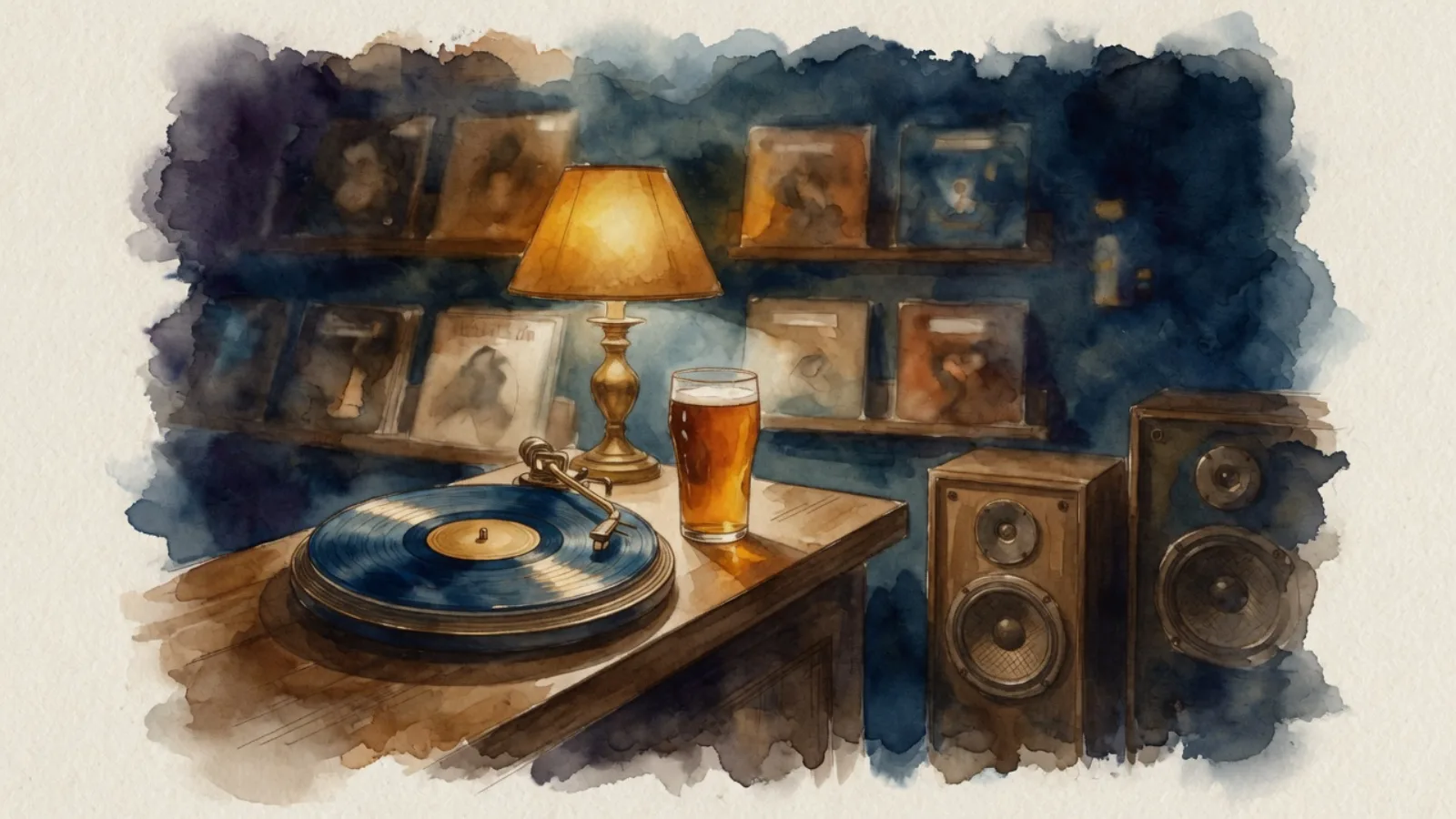
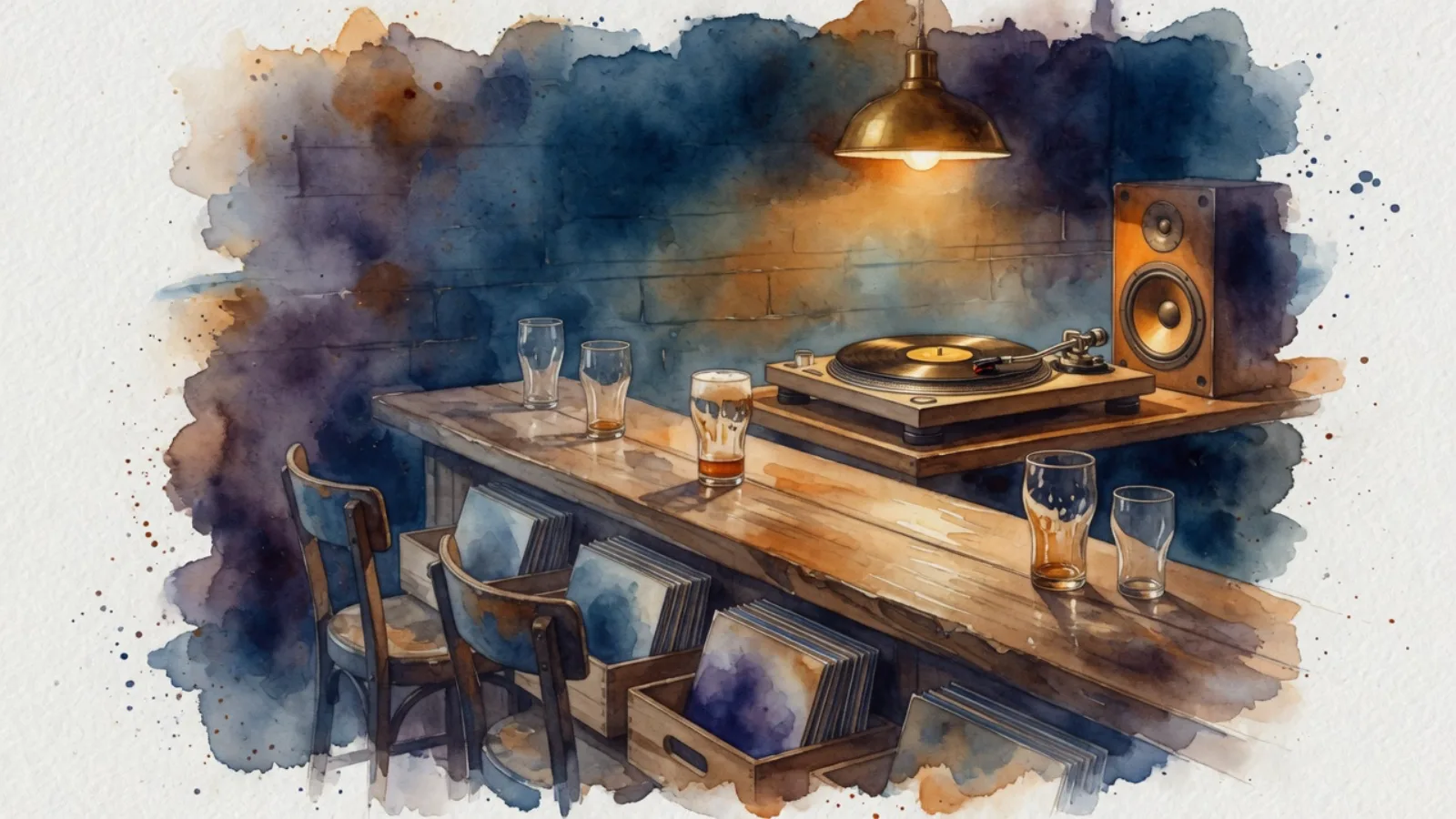
The title does the arguing. “If You are Sick of AI Jazz Playlist” is aimed at the endless machine-generated mood music now filed under jazz. The video’s counterargument is entirely physical: a Technics SL-1200MK5 turntable, a Nagaoka cartridge, a rotary mixer, a pair of giant JBL cinema speakers, and records whose sleeves were designed before anyone could type a prompt.
So the lens of this page is the room. Each chapter is one record: who was in the studio, what they did there, and one honest takeaway from that session. One note up front — although the title promises Blue Note hard bop, only three of the six tracks actually came out on Blue Note. The map below makes that visible.
A map of the session
Each row is a style, each mark is a track, and the horizontal axis is time in the video. Switch the coloring to read the same program by the label that released each recording. Click a mark to jump to its chapter.
Half of this “Blue Note playlist” isn’t on Blue Note
Each track is assigned to the label that first released its recording, weighted by running time. Blue Note accounts for about half of the session; the rest comes from Columbia, Atlantic and a small Danish label. The music is still all hard bop’s extended family — the brand is just smaller than the title suggests.
- On Blue Note28 min55%
- On Columbia8 min15%
- On Atlantic8 min17%
- On SteepleChase7 min13%
Hard bop’s rooms
0:00 – 0:25
One afternoon in a living room1957
- 0:00:00Blue Train — John Coltranefrom the album Blue Train, 1957
The record that opens the session was cut in a single afternoon: September 15, 1957, in Rudy Van Gelder’s parents’ living room in Hackensack, New Jersey — at the time the most important recording address in jazz. Blue Train became John Coltrane’s only album as a leader for Blue Note, and four of its five tunes were his own, including the title track you hear first.
Coltrane was thirty and still better known as a sideman. For the date he put a teenager at the front — Lee Morgan, nineteen, on trumpet beside Curtis Fuller’s trombone — over a rhythm section borrowed from Miles Davis’s quintet: Paul Chambers on bass and Philly Joe Jones on drums, with Kenny Drew on piano. One afternoon in Hackensack produced the album that hard bop is still measured against.
The rhythm section is also a plot point. Chambers and Philly Joe had spent the year before working under Miles Davis — which is exactly where the program goes next.
Listen forThe three horns state the head in unison, like a train whistle, then step aside. Listen for how confident Morgan’s trumpet sounds even next to Coltrane — he was nineteen that day.
The song that waited a year1956
- 0:10:39Bye Bye Blackbird — Miles Davisfrom the album ’Round About Midnight, 1957; song from 1926
Bye Bye Blackbird is the oldest song on the turntable: a 1926 pop tune by Ray Henderson and Mort Dixon, from the era of sheet music and vaudeville. Miles Davis recorded it on June 5, 1956 with his first great quintet — John Coltrane, Red Garland, Paul Chambers and Philly Joe Jones. The bass-and-drums pair behind Coltrane on the previous track is the same one here.
The recording then sat on a shelf for about a year. Davis had signed with Columbia after his 1955 Newport triumph with ’Round Midnight, but he still owed albums to his old label Prestige, and Columbia agreed to wait. ’Round About Midnight came out in 1957, once the old contract was spent.
On record the tune is a study in restraint: Davis states the melody slowly behind a mute, and the band answers him in whispers rather than statements.
Listen forThis is the only track on the program where the melody arrives already famous. Listen to how slowly Miles lets it unfold, and how Coltrane’s tenor pushes against that calm.
A bebop pioneer’s second room1973
- 0:18:30No Problem — Duke Jordanbest-known recording: Flight to Denmark, 1974
The video’s description names only the track and the composer, so this page cannot say which pressing is spinning. The best-known recording of No Problem is Duke Jordan’s own, cut in Copenhagen in 1973 and released in 1974 on the small Danish label SteepleChase, with the Danish bassist Mads Vinding and Ed Thigpen — the American drummer who had played for years with Oscar Peterson and eventually settled in Denmark.
Jordan’s credentials were from another era: he was the pianist in Charlie Parker’s 1947 quintet, on records like Chasin’ the Bird, and he wrote the standard Jordu. American fame faded early; Europe kept listening. He settled in Copenhagen in 1978 and lived there until his death in 2006, recording steadily for Scandinavian labels.
This is the only piano trio on the program and the only track recorded outside the United States — two decades later than everything else here, and an ocean away.
Listen forNotice how much space a trio leaves: brushes carry the swing, the bass does the walking a horn section otherwise would, and the melody stays singable from first chorus to last.
Outward, then home
0:25 – 0:51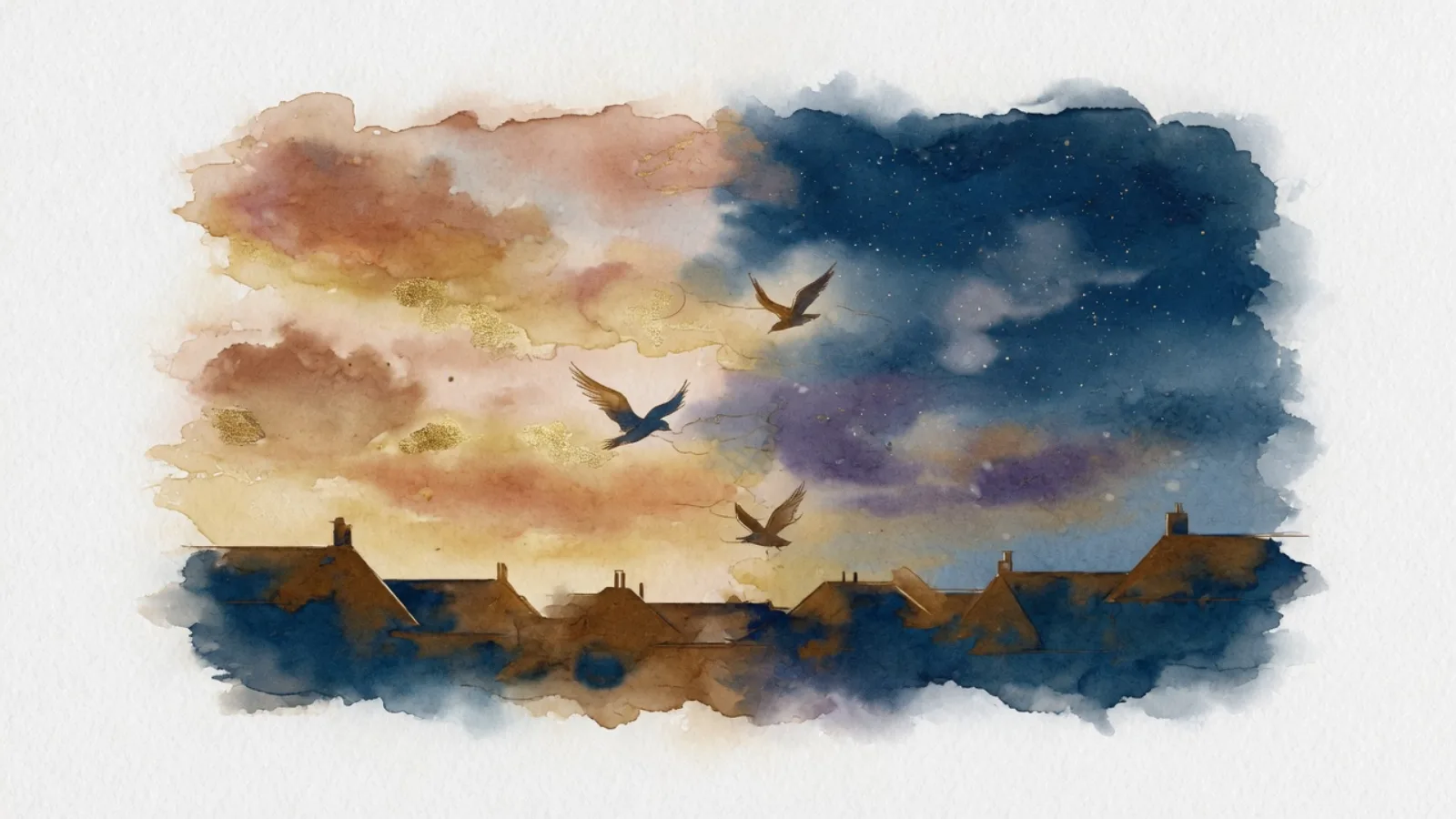
Named for a birthday1960
- 0:25:04Equinox — John Coltranefrom the album Coltrane’s Sound, recorded 1960, released 1964
Coltrane was born on September 23, 1926 — the date of that year’s autumn equinox — and this slow minor blues carries the day’s name. It is the deepest cut on the program: the album it comes from, Coltrane’s Sound, was recorded in October 1960 and then shelved by Atlantic for nearly four years, appearing only in 1964, when Coltrane’s fame had made his backlog valuable.
The band is the classic quartet early in its life: McCoy Tyner on piano, Elvin Jones on drums, Steve Davis on bass. Atlantic had signed Coltrane away from Prestige and was recording him faster than it could release him. The tune that keeps his birthday stayed in the drawer while the audience caught up; by the time it appeared, the band on it was already the most admired group in jazz.
Listen forIt is a minor blues that barely moves: the head sits low on the tenor, Tyner answers in block chords, and Elvin Jones keeps the whole slow engine rolling underneath.
The jingle that got away1965
- 0:33:31Maiden Voyage — Herbie Hancockfrom the album Maiden Voyage, 1965
Herbie Hancock wrote Maiden Voyage as background music for a television commercial that never aired. He kept the tune, and on March 17, 1965 he recorded it for Blue Note with what was essentially the Miles Davis Quintet with Freddie Hubbard sitting in Miles’s chair: George Coleman on tenor, Ron Carter on bass, Tony Williams on drums.
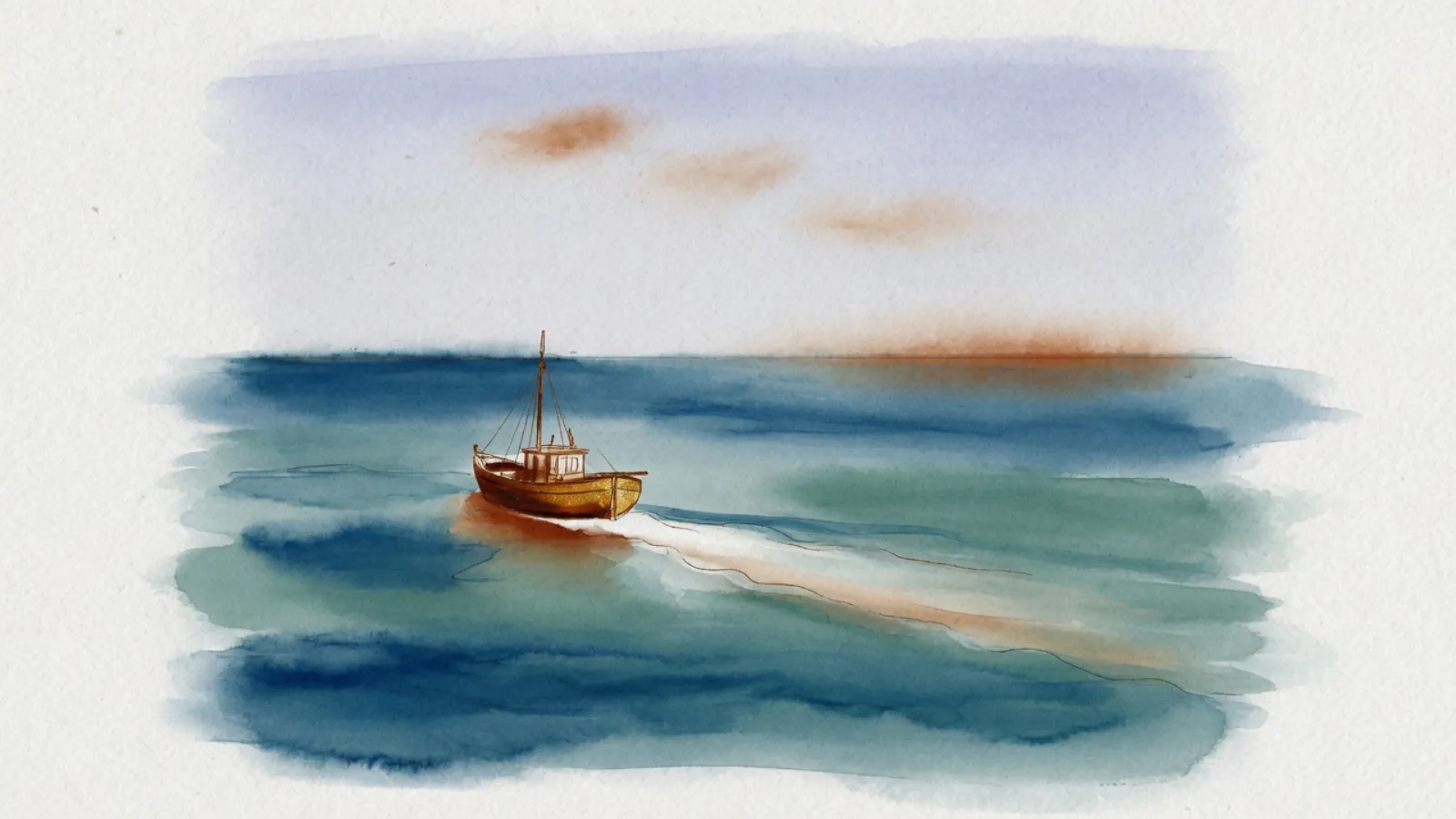
The album is a set of scenes about the sea, and the title track is its departure: a horn figure like a ship’s signal over chords that never fully resolve. Hancock has called it the best piece of music he ever wrote, and the album entered the Grammy Hall of Fame in 1999.
Listen forListen for the chord that refuses to settle — the harmony hovers instead of landing, which is why the music sounds like open water. Then wait for Hubbard’s trumpet to call across it like a horn from a ship.
The band that was a school1958
- 0:41:17Moanin’ — Art Blakey & The Jazz Messengersfrom the album Moanin’, 1959
The last record brings the program back to hard bop’s home address: recorded on October 30, 1958 — a year and six weeks after Blue Train, in the same Hackensack living room — and released in January 1959 as the defining album of this edition of the Jazz Messengers. Lee Morgan is here too, twenty years old now, two years after he sat in on Blue Train at nineteen.
The title track was written by the band’s twenty-two-year-old pianist, Bobby Timmons: a slow, gospel-tinged tune built on call and response, one half the horns shouting, the other half Art Blakey’s drums answering. Beside it, tenor player Benny Golson contributed Along Came Betty and Blues March.
Blakey kept the Messengers running for four decades, as much academy as band; its alumni list runs from Horace Silver and Hank Mobley through Wayne Shorter and Keith Jarrett. The record you hear here is the school in one class photo.
Listen forThe whole tune is a conversation: the front line calls a phrase, Blakey answers with a drum figure, over and over — church call-and-response carried into a basement club. Stay for his solo at the end.
The chain still holds
In Incheon, the session ends with the last side of Moanin’. The channel thanks its subscribers and promises more shoots in more Korean rooms. Citizen Brewing Community is both its home turf and the first space it ever filmed; a bossa nova set was recorded there before this one, and Side B — jazz funk, Brazilian music, soul — is already up.
The playlist’s argument is easier to see now. Between 1956 and 1973, six rooms of people made these six records: a label bet on an unknown bandleader, a bigger label waited out an old contract, an exile was welcomed abroad, a quartet outgrew its own release date, a jingle outlived its commercial, and a drummer kept a school running. Tonight a turntable in a beer bar plays the whole ledger for strangers, and more than a million of them have pressed play.
Whether a machine can generate pleasant background jazz is no longer really the question. What it cannot do is be in the room — and this page is an attempt to describe what was in these six. Every track above links back to the video; the right way to read it is with the record spinning.
The signal chain, straight from the video description
The human-made argument, in hardware. The description lists the whole setup: the needle that touches the groove at one end, the recorder at the other, and seven devices in between doing nothing that could not be heard.
- Technics SL-1200MK5Turntable. Spins the record.
- Nagaoka MP-110Cartridge. The needle in the groove.
- Pioneer XDJ-1000Digital player alongside the decks.
- Union Audio Orbit.4 LE fxRotary mixer.
- BSS FCS-966Graphic equalizer.
- dbx 160ACompressor.
- QSC DCA 3422Power amplifier.
- JBL 4622NCinema speakers, dual units.
- TASCAM DR-40XRecorder. What this video is.
The six rooms
Every track on the program, in playing order, with where and when its recording was made. The oldest recording here plays second and the newest plays third — the order is a DJ’s ear, not a timeline.
| Track | Recorded | Label | The room |
|---|---|---|---|
| Blue Train — John ColtraneSept 15, 1957 | One afternoon | Blue Note | Van Gelder’s living room, Hackensack; six musicians |
| Bye Bye Blackbird — Miles DavisJune 5, 1956 | One session, shelved a year | Columbia | The first great quintet |
| No Problem — Duke Jordan1973 (rel. 1974) | Two decades after the rest | SteepleChase | A Copenhagen trio, an exile’s welcome |
| Equinox — John ColtraneOct 1960 (rel. 1964) | Shelved four years | Atlantic | The classic quartet, early |
| Maiden Voyage — Herbie HancockMar 17, 1965 | Written for an ad that never aired | Blue Note | The Miles Davis Quintet with Hubbard |
| Moanin’ — Art Blakey & The Jazz MessengersOct 30, 1958 | One year after Blue Train | Blue Note | The school; a 22-year-old wrote the anthem |
All the takeaways
One lesson per record — 6 in total — each tied to the session it came from.
Independence
This page is an independent, non-commercial reading companion to a YouTube video. It is not affiliated with or endorsed by Locabrary, Citizen Brewing Community, or any record label. All music belongs to its respective owners; nothing here reproduces the video or its audio.
Sources
The track list, timestamps, venue, equipment and the two-language description come from the video itself. Recording dates, personnel and release facts for each track were cross-checked against Wikipedia, Discogs, the jazzdisco.org sessionographies, and Blue Note’s and Herbie Hancock’s official pages.
The “23 musicians” figure counts every named player in the six lineups above, with John Coltrane, Paul Chambers, Philly Joe Jones and Lee Morgan each counted once. It assumes the No Problem recording described in this page; see the note below.
Interpretation
The “rooms” framing, the chapter lessons, and the genre and label assignments are this page’s own editorial reading of verified facts, not claims made by the video or the musicians. The video itself is silent — it plays records.
Uncertainties
The video lists “No Problem — Duke Jordan” without naming an album. This page describes the best-known recording of that tune — the Copenhagen trio version from 1973–74 — but cannot confirm which record was actually spinning.
Accounts differ on what product Maiden Voyage’s never-aired commercial was for; this page says only that it was written as background music for a TV commercial that never aired.
Images
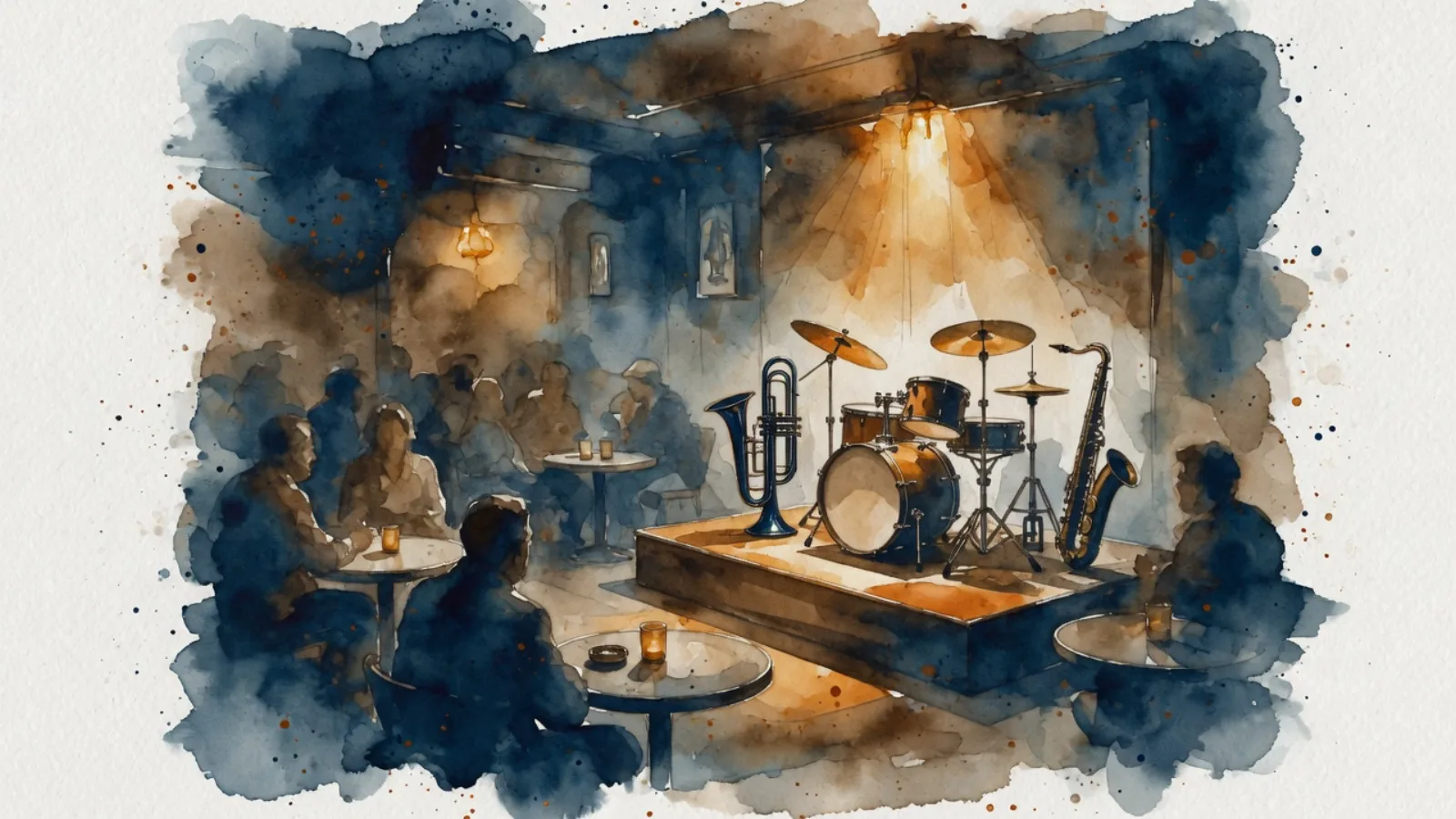
All illustrations on this page are AI-generated watercolor scenes, made for this page. They are illustrative, not documentary: they do not depict the real bar, the real studios, or the musicians, and they contain no text.